

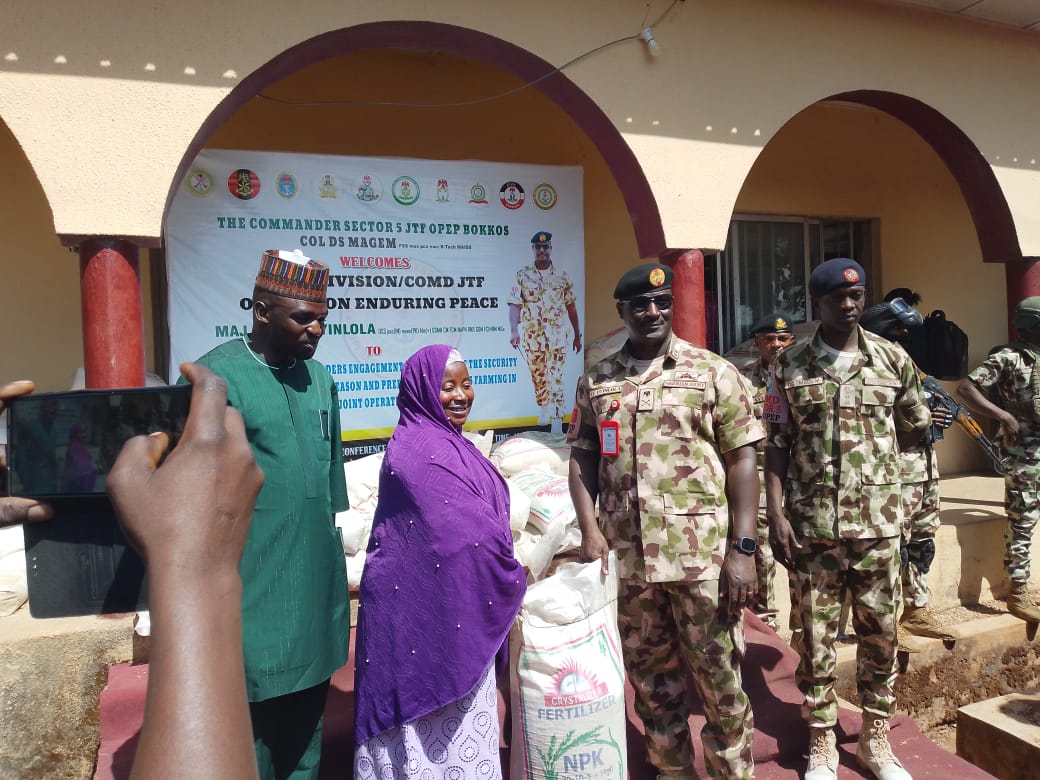
The Special Task Force on the Jos crisis, Operation Enduring Peace (OPEP), has distributed fertilizers to farmers in the area to help boost crop yield in the coming farming season. The distribution was done on Thursday in Bokkos Local Government during a stakeholders’ meeting in the local government area, organized by OPEP
The Commander of Operation Enduring Peace (OPEP), Major General Foluso Oyinlola, who also serves as the General Officer Commanding (GOC), 3 Division, Rukuba, said the Chief of Defence Staff approved the distribution of the fertilizers as a non-kinetic approach to promoting peaceful coexistence in the crisis-prone zone.
“In furtherance of this objective, I wish to inform you that the Chief of Defence Staff has graciously approved the distribution of fertilizers to stakeholders on both sides of the divide as a non-kinetic intervention to encourage farming activities,” he said.
Major General Oyinlola urged residents to remain vigilant, watch out for early warning signs of unrest, and promptly report such signs to the Joint Task Force.
“We cannot afford to ignore these early warning signs. Collective and timely action is required to prevent Bokkos from sliding into avoidable conflict. The farming season is about to commence, and for many families, this period is critical to securing their livelihoods. Any disruption to farming activities at this stage will have far-reaching consequences throughout the year and beyond.”
The Army Chief said the engagement was necessary, noting that, “we convened to listen to you, understand your concerns, jointly develop workable strategies, and reaffirm our shared commitment to peaceful coexistence.”
The OPEP Commander commended the people of Bokkos for their commitment to peace and harmony.
“Over the past months, there has been a noticeable decline in violent incidents within the area. This relative calm did not occur by chance; it is the product of sustained dialogue, deliberate conflict-mitigation efforts, community cooperation, and a collective resolve to set aside differences for the greater good,” he said.
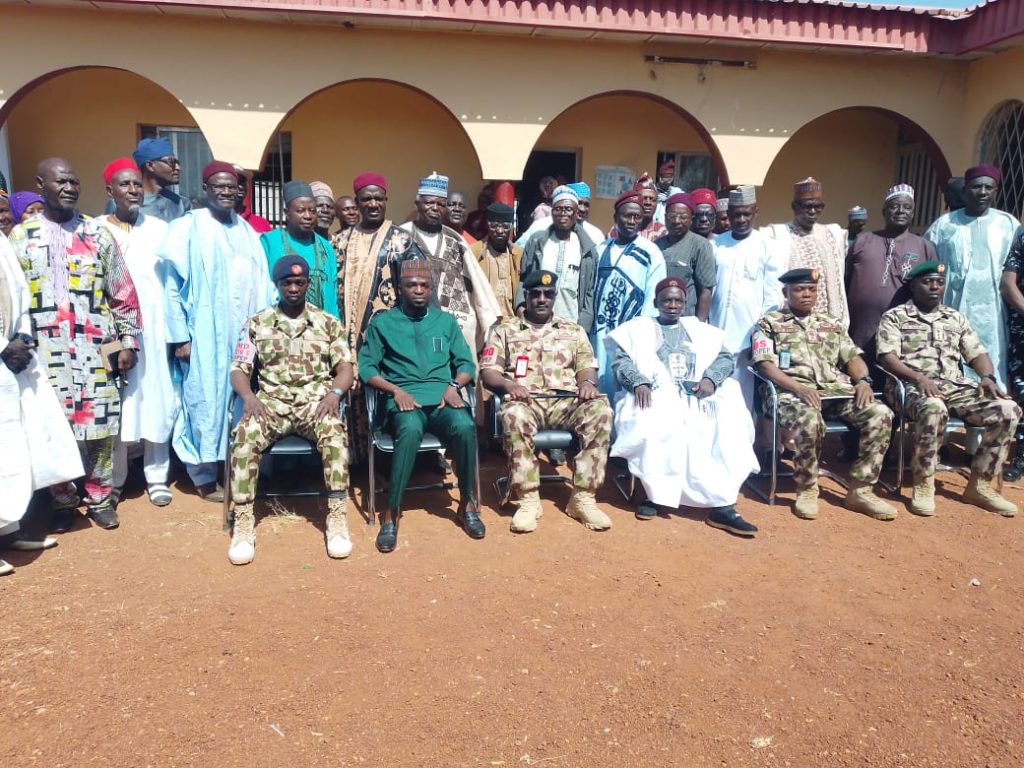
He added: “We owe it to our children to bequeath a legacy of peace rather than conflict, and we owe it to ourselves to rise above hatred and embrace the bonds of brotherhood and sisterhood. I therefore urge you to leave this engagement with a renewed sense of urgency and responsibility. The time to act is now.”
Major General Oyinlola assured that the Joint Task Force would continue to maintain peace in the area, calling on citizens to report criminal activities. He noted that offenders would be prosecuted accordingly, stressing that anyone involved in crimes, particularly kidnapping and motorcycle snatching, would face the full wrath of the law.
Speaking at the event, the Chairman of Bokkos Local Government Council, Amallau Samuel Amallau, appreciated the GOC and the entire OPEP team for securing the lives and property of citizens.
In an interview with journalists, the council chairman said his administration had consistently engaged stakeholders on the need for peaceful coexistence. He explained that the council spends huge sums managing insecurity, including settling hospital bills for the injured, purchasing fuel, and repairing operational vehicles used by the Task Force to aid its operations.
Some natives of Bokkos who spoke at the meeting called for intervention to enable displaced persons to return to their ancestral homes. A 72-year-old man, Michael Yilkis, and a youth leader, Sabastine Magik, accused Fulani herders of killing people and perpetrating various crimes such as kidnapping, destruction of farm crops, rape, motorcycle snatching, and isolated killings.
Similarly, Fulani representatives at the meeting, Sale Yusuf Adam and Saidu Adamu, accused Bokkos natives of preventing their people from grazing their cattle freely.
The Fulani representatives revealed that a three-man committee of herders had paid nearly ₦20 million over the past three years as compensation for crop destruction caused by cattle, in an effort to maintain peace. They also accused some natives of poisoning grazing areas where their cattle feed, and alleged that Fulani herders were barred from accessing certain locations.
Speakers from both sides called for sustained dialogue to foster peaceful coexistence between natives and herders, while others appealed for increased security presence across all communities in Bokkos Local Government Area.
During the engagement, participants affirmed that criminal activities had relatively reduced and called for a permanent cessation of hostilities.