


On February 3, 1976, Benue State was born and almost instantly, it began to speak. From the early crackle of radio signals to the steady rhythm of freshly printed newspapers, the media became the state’s memory, mirror, and moral compass. For five decades, Benue’s media has served as witness, watchdog, chronicler, and, at critical moments, the conscience of the state.
As Benue marks its golden jubilee, this milestone invites reflection not only on political or economic achievements, but on the journey of the institutions that told Benue’s story to itself and to the world. The history of the media in Benue is, in many ways, the history of the state: hopeful beginnings, seasons of influence and relevance, painful decline, and a stubborn refusal to be silenced.
From inception, the media in Benue State was entrusted with a sacred responsibility to inform, educate, enlighten, preserve culture, and strengthen democratic ideals. Early leaders understood that a young state required a credible and unifying voice. That understanding led to the creation of state-owned media institutions that would go on to shape public discourse for decades.
At the heart of Benue’s media architecture stood the Benue Printing and Publishing Corporation (BPPC), established by Edict No. 1 of 1976. The corporation was mandated to project government policies, promote development programmes, and serve as a bridge between the government and the governed. Under this umbrella, The Voice Newspaper was born.
The newspaper arm began modestly as The Nigerian Voice, first published on Friday, July 6, 1979, as a weekly paper under the Ministry of Information through the Directorate of Information, then headed by the late Dan Agbese. Few could have predicted that this humble beginning would grow into national relevance.
Structurally, BPPC was designed as a full-fledged media house, comprising seven departments : Administration, Commercial Printing, Editorial, Finance and Supply, Production, Marketing, and Maintenance coordinated by the General Manager.
Former General Manager and Editor, Dr. Ben Ebe, recalls the defining moment that announced the newspaper’s national stature. In 1982, President Shehu Shagari personally commissioned The Nigerian Voice. “It was a three-day event,” Dr. Ebe recalled. “President Shagari himself pressed the button.”
Daily publication commenced on April 8, 1982. By October 1, 1987, the paper was rebranded The Voice, and by 1988, BPPC had expanded to four titles: The Voice (daily), The Sunday Voice, Voice Sports, and Weekend Express.
Dr. Ebe described this era as one of unmatched professionalism and national relevance.
“President Shagari took a strong interest in the paper and ensured it was the first newspaper on his desk. At the time, The Voice was believed to represent Northern Nigeria, not just Benue State. It served the interests of the entire North and the then 19 states.”
Funding was steady, recruitment strictly professional, and diversity flourished. Journalists and production staff were drawn from across Nigeria—Igbo, Yoruba, Edo, Cross River, Plateau—and even beyond the country. “We had Ghanaians and even a Cameroonian, Chris Garba, who later joined Daily Times,” he added.
Between 1986 and 1988, under the leadership of Mr. Dan Okolo, whom Dr. Ebe described as an exceptional writer, The Voice reached its editorial peak. One of its most successful innovations, Weekend Express, began as a single entertainment page before growing into a full-fledged Saturday publication.
“We never lacked materials,” Dr. Ebe said with a grim smile. “Other states came to borrow newsprint from us. Our warehouse was full. Kabiru Yusuf of Daily Trust came to learn newspaper production here. Students from the University of Lagos, Bayero University, and others did industrial training with us. That tells you how strong The Voice was.”
Under the Aper Aku administration, The Voice achieved daily national circulation, with offices across the North and beyond. It printed up to 12,000 copies daily, operated 24 hours, ran staff buses, and was reviewed daily on FRCN. At a time when salaries elsewhere were unpaid, Voice staff were paid promptly.But the roar did not last.
The administration of Rev. Fr. Moses Orshio Adasu shut down the corporation without a comprehensive diagnosis of its challenges. Though reopened in 1992 and declared a limited liability company, the transition lacked legal clarity. The original edict was never repealed, nor was the new entity properly registered with the Corporate Affairs Commission leaving the paper legally stranded.
Under Governor George Akume, matters worsened after the publication of the editorial “Enough Is Enough.” “I wrote it,” Dr. Ebe said calmly. The entire management was sacked. A sole administrator was appointed. Stability gave way to disruption.
A revival came in 2007 under Governor Gabriel Suswam, who recalled the dismissed management and reinstated Dr. Ebe. Within months, overhead funding returned, production resumed, pagination increased, and popular pull-outs were revived. A ₦164 million Impactor printing machine one of the most advanced in the North Central zone was procured in 2012 but, sadly, never installed.
Innovation helped sustain the paper. Partnerships with local governments for goodwill messages during national celebrations generated revenue and kept production alive. Dr. Ebe also recalled inviting Governor Hyacinth Alia then a Reverend Father to The Voice in 2005.
“He came, anointed the organisation, and prayed with us,” he said.
Under Governor Samuel Ortom, renovation contracts were reawarded and progressed to about 80 percent completion. During this period, Mr. Anza Philips served as GM (2016–2020), followed by Ben Agande (2020–2023), who launched The Voice online platform, upgraded ICT infrastructure, and renovated the administrative block.
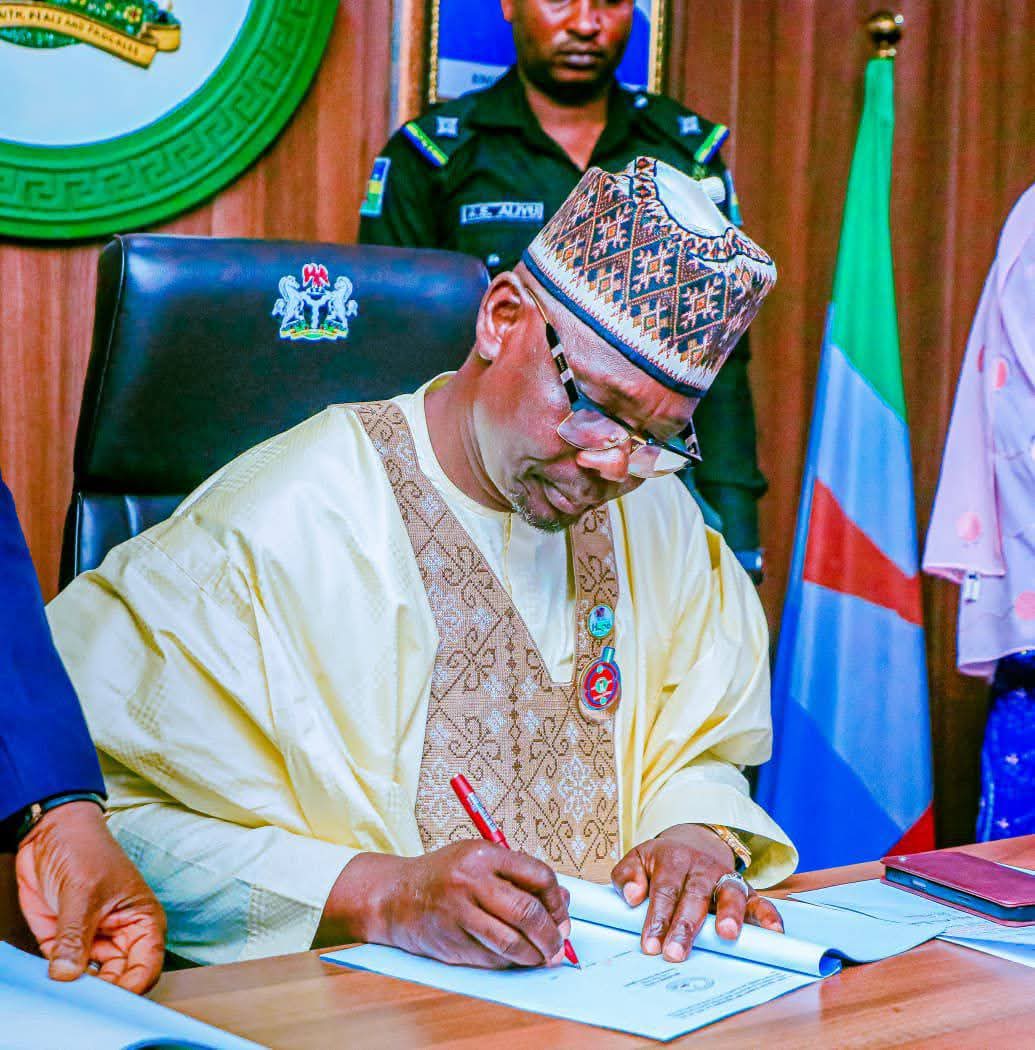
A new chapter opened on February 22, 2024, when the Alia-led administration signed a Public-Private Partnership agreement with Shimatex Nigeria Ltd. This culminated in the commissioning of the printing press on August 27, 2024, with commercial printing now managed by the private partner under Mr. Joel Mtor. But rather than a solution, it appears another confusion; two managements in one organisation and The Voice still groping for footing.
Over the years, The Voice has produced some of Nigeria’s finest media professionals many of whom are now media owners, commissioners, chiefs of staff, press secretaries, permanent secretaries, and heads of parastatals.
Dr. Ebe insists that government media should not be viewed purely as revenue-generating ventures.
“You must invest to sustain it. If properly funded, it will generate income, add value to government, and serve the people effectively as information carriers.”
Despite innovation and partnerships that kept the paper alive, decline set in. Since 1995, publication has remained irregular due to poor funding, obsolete equipment, and infrastructural decay. Yet, even in decline, The Voice has endured never fully silenced.
Speaking on the state of affairs, Acting GM of BPPC, Mr. Samuel Atachin, observed that Benue has produced outstanding journalists, but institutional media has lagged due to neglect. “Our online platform sustains relevance,” he noted. “Even when the hard copy is absent, the voice remains.”
Similarly, Radio Benue was established as tge state’s pioneer radio stationand quickly became a trusted ally especially in rural communication.
Originally coming as part of the Nigerian Broadcasting Corporation, Radio Benue became a state-owned station in 1978 following a federal handover. Edict No. 4 of December 14, 1978 formally christened it Radio Benue. The station was officially commissioned on December 3, 1991, by Head of State General Ibrahim Badamasi Babangida.
Over time, Radio Benue expanded into a network with sub-stations in Katsina-Ala and Idekpa, serving neighbouring states and regions. It has braced the trail in broadcast journalism in Benue and beyond.
Like The Voice, Radio Benue has suffered from inadequate funding, manpower shortages, decaying infrastructure, and obsolete equipment. Since inception, it has been led by 13 General Managers and Directors-General, including Niran Ogungbemi, Dan Agbese, Maria Odeh, Elvis Attah, and currenty Terzeer Mnzuulgha.
The establishment of Benue Television (BTV) further expanded the state’s media footprint. Initiated under Governor George Akume and backed by a 2008 Act of the State Assembly, the administrative block and equipment were procured.
Under Governor Suswam, studios were built and equipment installed, though operations remained skeletal. Full reconsideration came under Governor Samuel Ortom, leading to the appointment of Dr. Patience Achapa-Ikyo as DG in 2020. BTV began as an online station before expanding to satellite transmission via NIGCOMSAT and StarTimes, dramatically increasing its reach.
Media deregulation opened the space for private, faith-based, and community stations, diversifying content but also introducing ethical challenges—particularly in the digital space. Social media platforms expanded access but fuelled misinformation and weakened professional standards.
At 50, Benue has come of age. Like a person entering maturity, the state must now invest deliberately in institutions especially the media that shaped perception, accountability, and development.
Benue’s media story is not merely one of decline, but of resilience. Its voice may have faltered, but it has never been lost. With proper funding, legal clarity, and political will, that voice can once again rise stronger, clearer, and more confident as Benue steps into its next half-century.