

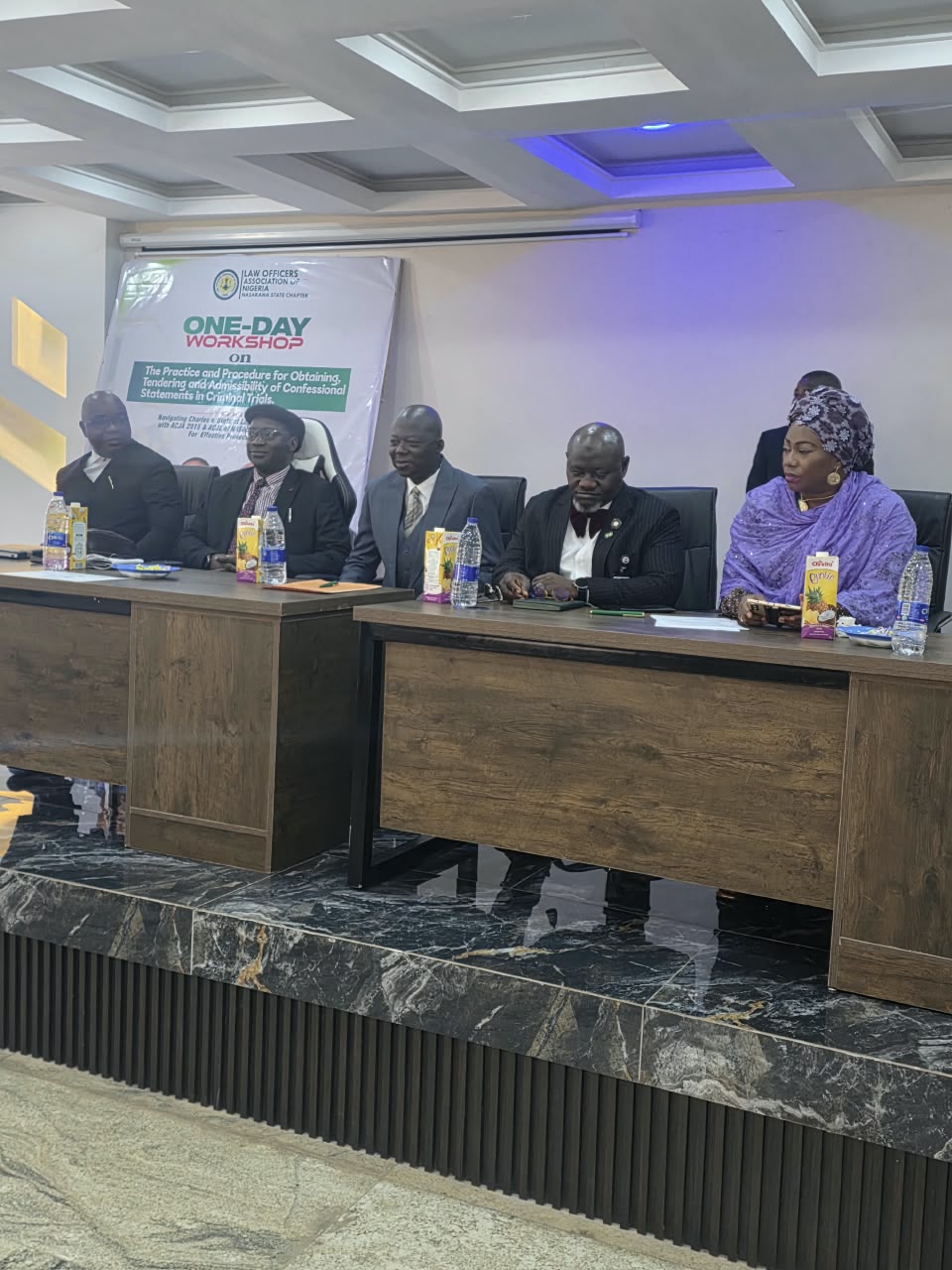
Key stakeholders in the criminal justice system converged on Lafia on Monday to find solutions to recurring legal bottlenecks leading to the dismissal of high-profile criminal prosecutions over improperly obtained confessional statements.
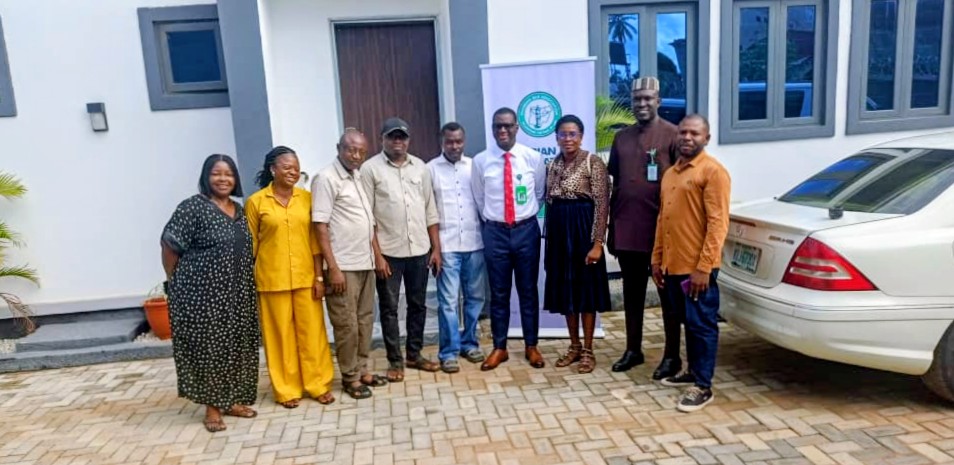
The one-day intensive workshop, organised by the Nasarawa State Chapter of the Law Officers Association of Nigeria (LOAN), focused on the practice and procedure for obtaining, tendering, and admitting confessional statements in criminal trials.
Held with the theme: “Navigating Charles v. State of Lagos and Compliance with ACJA 2015 & ACJL of Nasarawa State, 2018 for Effective Prosecution”, the Nasarawa State Governor, Abdullahi Sule, commended the initiative for uniting security agencies, prosecutors and the bench under one roof, noting that past fragmentation often bred inter-agency rivalry.
Represented by the Secretary to the State Government (SSG), Dr. Labaran Magaji (SAN), the governor reaffirmed his administration’s commitment to the rule of law and judicial independence, stating that his government maintains a strict policy of non-interference in judicial processes, which, he said has helped preserve peace and attract investments to the state.
”Bringing all the agencies together under one roof has really underscored the inter-agency collaboration in our criminal justice system.The government still maintains its stand that on no account should any judicial process be compromised for whatever reason,” Sule said.
Urging law officers to continually update their legal knowledge rather than relying solely on routine courtroom appearances, Gov Sule likened unsharpened legal skills to a woodcutter whose daily output drops because he fails to sharpen his axe.
”You are always excited going to court and reviewing your case file, but when you fail to understudy trending and emerging legal issues, rather than winning more cases, you end up losing them,” he cautioned.
In his remarks, the State Attorney General and Commissioner for Justice, Hon. Isaac Danladi, described the workshop as a major milestone in strengthening criminal prosecution amid evolving security challenges.
He noted that the Administration of Criminal Justice Act (ACJA) 2015 and its domestication as the Nasarawa State Administration of Criminal Justice Law (ACJL) 2018 have fundamentally transformed how confessional statements are handled.
”Unlike the previous regime, where obtaining and tendering confessional statements by the police and prosecutors was treated as a merely administrative process without legal consequence, the ACJA and the Nasarawa State ACJL 2018 have created a binding obligation on law enforcement to comply with strict procedures before such statements become admissible judicial evidence,” Danladi explained.
Representing the Chief Judge of Nasarawa State, Justice Aisha Lawal Uthman, Hon. Justice Abdullahi Shammah lamented that courts are frequently forced to acquit defendants in otherwise strong criminal cases because investigators fail to follow statutory procedures when recording statements.
”You see a good case where ordinarily the defendant ought to be kept out of circulation to serve as a deterrent, but due to how the process of obtaining his statement was faulted, the judge has no option other than setting him free,” she noted, adding that such defendants often return to society to commit similar offenses.
She also pointed out the practical challenge of inadequate video-recording facilities across security agencies, as required by law when legal representation is absent during interrogation.
Speaking on behalf of the private bar, the Chairman of the Nigerian Bar Association (NBA), Lafia Branch, Abdullahi Gayam, Esq., observed that all arms of the justice sectorsecurity agencies, prosecutors, defense counsel, and the judiciary face public scrutiny over trial outcomes.
”Security agencies raise serious concerns about the rate at which defendants accused of serious crimes are released, the judiciary is concerned about how investigations are conducted, and private lawyers complain about how suspects are taken into custody and interrogated,” Gayam said, describing the forum as a timely avenue to bridge those gaps.
In an interview on the sidelines of the event, the Chairman of the Law Officers Association, Nasarawa State Chapter, Raymond Umoru, Esq., revealed that roughly 90 percent of evidence relied upon by state prosecutors consists of confessional statements, making compliance with statutory safeguards critical.
”Many of our confessional statements have been thrown out by the courts for lack of compliance with recent developments in the law.
“A suspect is entitled to have his lawyer, family members, or a civil society representative present when his statement is recorded, or where unavailable, the law mandates that the statement be video-recorded to prevent torture and protect the defendant’s rights. Once investigators get the foundation right, it becomes much easier for prosecutors to secure justice.”
The technical sessions were facilitated by Hon. Justice Solomon W. Ayenajeh of the Nasarawa State Judiciary, who spoke on the judicial approach to voluntariness and probative value under ACJA 2015 and ACJL 2018; the 2nd Vice President of the NBA, Nuhu John Egya, Esq., examined practical steps from investigation to trial; and human rights legal practitioner, Emmanuel Kuza, Esq., addressed investigative best practices for securing admissible statements.
The workshop drew participants from the Nigeria Police Force, Nigeria Security and Civil Defence Corps (NSCDC), Department of State Services (DSS), National Drug Law Enforcement Agency (NDLEA), National Agency for the Prohibition of Trafficking in Persons (NAPTIP), Magistrates’ Association of Nigeria, and the NBA Lafia and Keffi branches.