

Africa’s leading agricultural development organisations are calling for a fundamental shift in how agricultural innovations are scaled across the continent.
Leaders and experts gathered in Abuja emphasising that Africa’s greatest challenge is no longer the generation of new technologies but the creation of integrated systems that deliver proven innovations to millions of smallholder farmers.
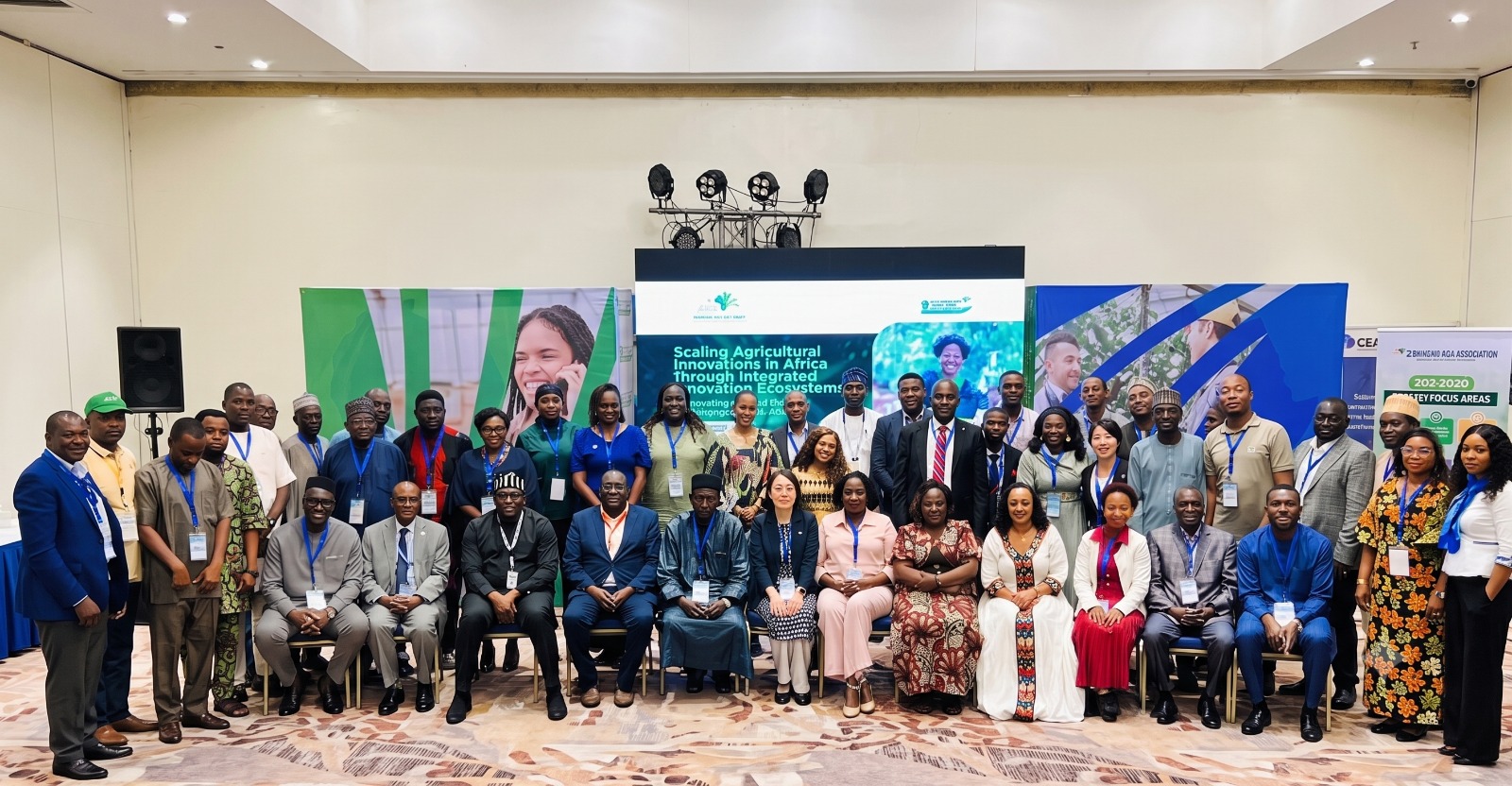
They made the call during a high-level side event organised by the Sasakawa Africa Association (SAA) at the 9th Africa Agricultural Science Week (AASW) and 10th General Assembly of the Forum for Agricultural Research in Africa (FARA), where SAA served as an official sponsor.
According to a Press statement issued on Monday by Mr. Moses Nongoatse, Country Communications Officer, SAA Nigeria, the event, themed: “Scaling Agricultural Innovations in Africa through Integrated Innovation Ecosystems: Transforming Agrifood Systems in Nigeria and Across Africa,” convened policymakers, researchers, extension practitioners, development partners, and private sector leaders.
Nongoatse explained that during the meeting, SAA’s Managing Director, Ms. Emiko Mutsuyoshi urged stakeholders to move beyond technology creation toward systemic, large-scale implementation.
”Our focus is on scaling what works. Africa already has many proven technologies, models, and partnerships. The challenge before us is to connect them better, invest in them more strategically, and ensure they reach farmers at scale,” She said.
Similarly, discussants echoed this perspective, stressing that sustainable agricultural transformation cannot occur through technology delivery alone.
They said, it requires an integrated innovation ecosystem that links research, extension services, markets, rural finance, and supportive government policies around smallholders’ everyday needs.
The Country Director of SAA Nigeria, Dr. Godwin Atser who presented concrete evidence of the impact, revealed that regenerative agriculture initiatives in Nigeria have already reached over 20 million farmers.
Dr Atser highlighted that the Kano State Agropastoral Development Project (KSADP), funded by the Kano State Government and implemented by SAA had demonstrated how coordinated investments in seed systems, extension services, mechanisation, and market access directly improve rural livelihoods.
Accorrding to the statement, some key insights from Pan-African stakeholders;
African Development Bank (AfDB), Dr. Martin Fregene advocated for the “Triple Helix” model fostering tight collaboration among government, industry, and research institutions to de-risk agricultural investments and expand credit access.
While Alliance for a Green Revolution in Africa (AGRA), Dr. Esther Ibrahim highlighted the necessity of end-to-end value chain support.
”Technologies alone cannot transform agriculture unless farmers also have access to financing, advisory services, storage facilities, and reliable markets,” Dr. Esther Ibrahim, Program Officer, AGRA said.
On his part, Country Director, SAA Uganda
Mr. Robert Anyang emphasised shifting the view of farmers from “project beneficiaries” to active commercial partners within local value chains.
Also Country Director SAA Ethiopia, Dr. Fantahun Mengistu shared lessons from Ethiopia’s extension legacy, outlining SAA’s strategy across three core pillars: Climate-Resilient Agriculture Systems, Safe and Nutritious Food Systems, and Inclusive Market and Agribusiness Development.
Head of TAAT, Dr. Solomon Assefa Gizaw, summarised four essential drivers for continental scaling: proven technologies, enabling public policies, sustainable financing, and strategic partnerships.
On-the-ground impact in Nasarawa State,
following the Abuja conference, the SAA leadership delegation conducted a two-day working visit to Nasarawa State to engage directly with local farmers, state officials, and community enterprises.
The delegation inspected Community-Based Seed Multiplication (CBSM) plots, family demonstration gardens, and processing infrastructure, including the Japanese Ministry of Foreign Affairs-funded 300 MT Rice Value Chain Development Centre in Assakio, Lafia LGA.
”The Centre currently employs over sixty members of the community and has revolutionized rice cultivation and processing in the area,” Mr. Emmanuel Angulu, Center Manager, Assakio Rice Value Chain Development Centre said.
The field mission concluded with bilateral discussions between SAA leadership, the Nasarawa State Ministry of Agriculture, and the Nasarawa State Agricultural Development Programme (NADP) to expand successful agrifood interventions across the state.
The Voice reports that SAA was established 1986 and has worked alongside African governments, research institutions, and farming communities to build resilient, inclusive, and sustainable agrifood systems.
The organisation is committed to strengthening extension networks and boosting commercialisation, as well as empowering smallholder farmers across the continent to improve productivity, nutrition, and income.