

Stakeholders from the 13 local government areas of Nasarawa State have demanded radical fiscal reforms in the implementation of the upcoming budget.
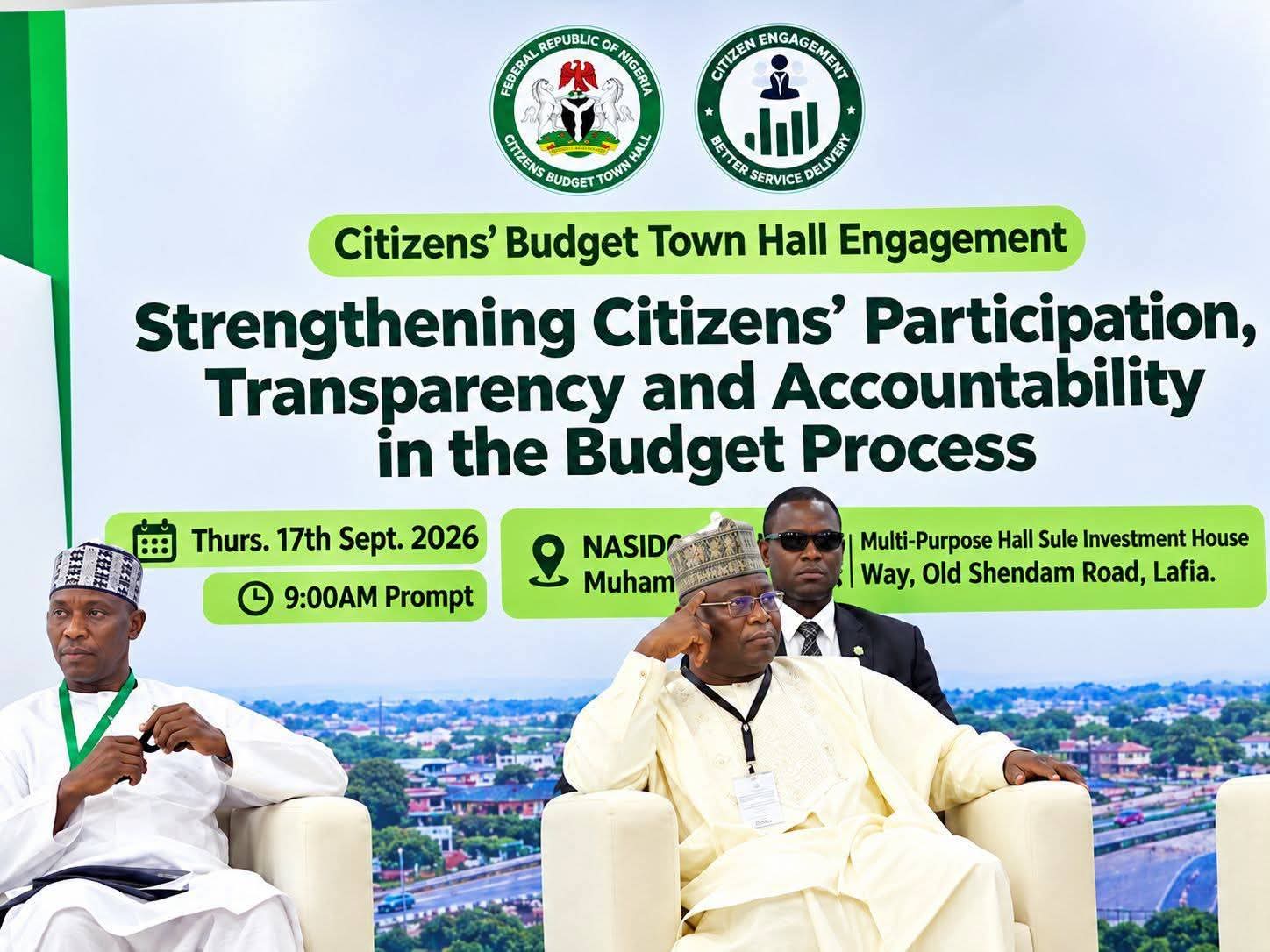
The stakeholders presented their demands during the 2027 Citizens’ Budget Town Hall Engagement held in Lafia on Thursday under the theme “Strengthening Citizens’ Participation, Transparency, and Accountability in the Budget Process.”
Speaking, Safiyanu Hassan, representing the Health Care and Primary Health Care Development group, highlighted severe limits within the Nasarawa State Health Insurance Scheme (NASHIA), where rural patients are forced to pay out-of-pocket for essential medications costing above N2,000.
”Most of the primary health care centers in the rural areas are experiencing lack of enough drugs, any drugs above N2,000 must be paid by user. So there is need for government to look into that,” Hassan said.
Hassan also demanded the immediate construction of a new General Hospital in Lafia to absorb patient traffic following transfer of Special Hospital, Lafia to Akwanga by the state government .
He also called for intensified measures against Lassa fever and stricter oversight of medical staff.
In a presentation on behalf of the Education and Human Capital Development group, Mohammed Yahaya decried the acute lack of teaching staff and basic infrastructure in rural public schools.
”If you go to our rural communities, you will see that there are no teachers in the classrooms. In a whole school, you will notice that there are only four or three teachers handling all subjects,” Yahaya stated.
He further condemned the high cost of special needs education, revealing that fees in specialised public schools have climbed to N60,000 per term.
”We say we want to encourage people with special needs to go to school, but today, parents cannot afford to pay school fees for their children with special needs. High school fees paid in special needs is alarming,” he said.
For Agricultural and Rural Development, Daniel Alanji criticised political intermediaries for diverting state-subsidised fertilisers and machinery away from actual smallholder farmers.
”When inputs are being distributed, the politicians used to be the ones to provide the beneficiaries, so it doesn’t get to the rural farmers,” Alanji stated, urging the state to dedicate at least 15% of the total 2027 budget to agriculture.
Alanji also urged urgent rehabilitation of unpaved agrarian transport corridors including the Ara-Tutu-Karshi road in Karu, the Onda road in Nasarawa Local Government, and key routes in Doma and Loko which cause severe post-harvest losses during rainstorms.
Addressing community development, Ahmed Yusuf presented a track record of abandoned state investments, calling for immediate performance audits.
”In my local government, there is a water project commissioned during Al-Makura’s tenure worth N2.1 billion. Up to this moment, there is no single water in that community,” Yusuf revealed.
Yusuf also requested immediate funding to complete the long-abandoned Persons with Disabilities headquarters, restore the neglected Nasarawa town market, repair primary schools, and construct urgent drainage channels along Doma Road in Lafia to prevent annual flooding.
Dauda Duglu, speaking for the Security, Water, and Sanitation group, urged the state water agency to shift its focus from drilling new boreholes to fixing broken rural water systems. He also advocated utilising major water reservoirs like the Doma Dam for local hydroelectricity generation.
Addressing local security, Duglu insisted on stronger enforcement of anti-kidnapping laws, direct support for vigilante groups, and mandatory residency for local government chairmen.
”Somebody cannot be a chairman of a local government and you don’t stay in your area. The Governor should direct every local government chairman to stay in his local government headquarters so he will know the security situation of his people,” he added.
On public health, Duglu urged state waste management authorities to immediately clear refuse heaps following monthly sanitation exercises, pointing to severe blockages in high-density Lafia neighborhoods like Rimi Uku and Shandam Street.
Advocating for social inclusion, Janet Idris called for decentralised skill acquisition centers, second-chance education platforms for women, and transparent employment channels.
Adding to economic policy reforms, Jatau Namo-Francis advocated for a fully digitalised public sector recruitment platform to end political patronage, alongside upward reviews of hazard and wardrobe allowances for teachers.
Namo-Francis also urged the state government to halt the raw exportation of solid minerals extracted from Nasarawa saying :”Government should make it a policy that minerals extracted from Nasarawa State should not just be taken raw outside. We should ensure that they are processed and refined here in the state to create jobs for our youth.”
Responding, Commissioner for Budget and Economic Planning, Hon. Ahmed Yakubu Muhammad, acknowledged that government budgets must be grounded in human realities rather than numbers.
”A budget is much more than a collection of figures on paper. Behind every budgeted figure is a road that needs to be constructed, a school that needs to be equipped, a health facility that requires attention, a farmer who needs support, a young person looking for opportunity, and a community aspiring for a better quality of life.
“When citizens participate in the budgeting process, they are helping government to understand human needs behind those figures,” Muhammad stated.
Responding to the extensive stakeholder submissions, the Commissioner assured participants that public spending in 2027 will be reshaped around grassroots priorities noting that some concerns raised by the participants were already being implemented by the state government.
He said that the Ministry of Budget and Economic Planning committed to subjecting all stakeholder proposals to technical review for integration into the executive budget proposal before its final presentation to the Nasarawa State House of Assembly.
The Permanent Secretary of the Ministry, Alhaji Isa Abdul Osama, noted that citizen input is legally backed by Section 3.1 of the Nasarawa State Fiscal Responsibility Law and international fiscal standards.
”Budget is no longer a government secret. Budget is your money. His Excellency, Engineer A. A. Sule, has always believed that the best budget is the one that comes from the people. We are here to listen to you and capture your priority needs,” Osama said.
Outlining how the stakeholder feedback would be processed, the Director of Budget, Ataka Akolo Peters, explained that technical breakout groups were specifically structured so citizen proposals could be submitted directly into official sector-by-sector planning templates.
The town hall concluded with the drafting of an official communiqué compiled by rapporteurs and civil society representatives.
The Voice reports consultative forum brought together civil society organisations (CSOs), traditional and religious leaders, persons living with disabilities (PWDs), women and youth groups, organised labour, academia, and media representatives to directly challenge state spending priorities.