


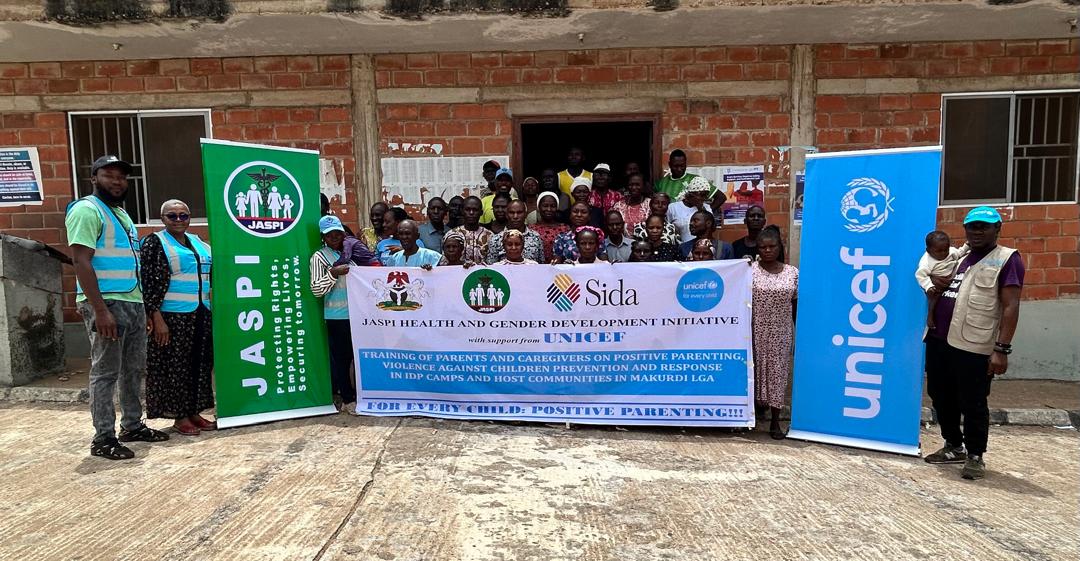
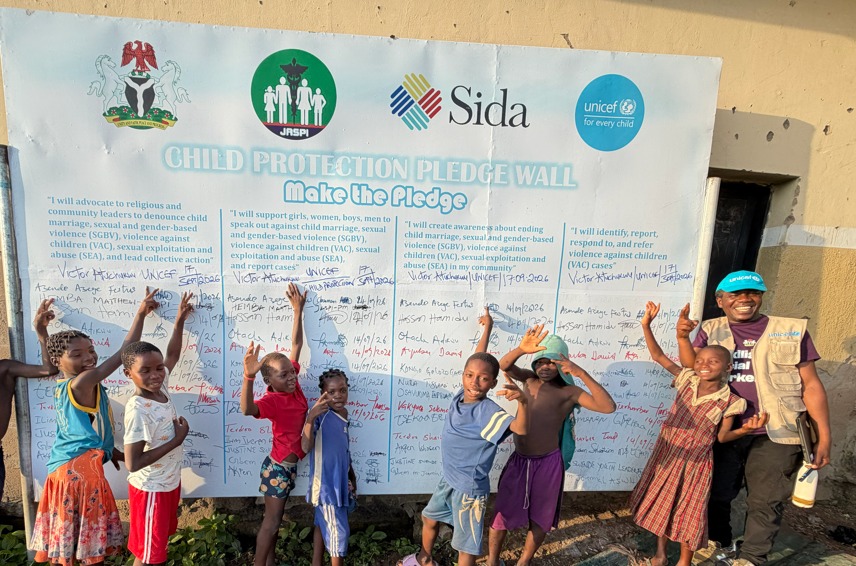
In the crowded shelters of Benue’s Internally Displaced Persons camps, where trauma, loss and uncertainty have strained family bonds, a quiet transformation is taking place. Parents who once ruled their homes with beatings and harsh words are now learning to talk, listen, and discipline with love.
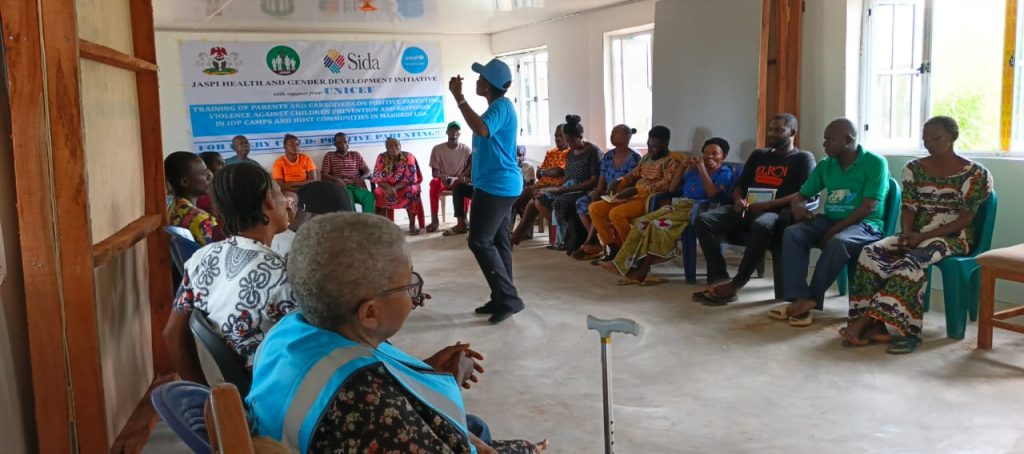
The change is driven by the JASPI Health and Gender Development Initiative, with support from UNICEF, which is implementing a 10-session training on Positive Parenting and Prevention well as Response to Violence Against Children in IDP camps and host communities across three local government areas of Guma, Gwer West and Makurdi.
The intervention targets 600 parents and caregivers across 20 locations. According to the Programme Manager, Matthew Hemba, 40 Master Trainers were trained to step down the knowledge. Each location has 30 participants, selected to become ambassadors in their communities.
In Makurdi, the project covers 7 locations including Nyiman Community, Abagena IDP camp, International Market IDP camp and host community, Mega IDP camp, Ichwa IDP Camp, Tyongiga Community in North Bank and Ashar Community in North Bank.
In Guma LGA, it covers 8 locations: Daudu 1 IDP Camp, Ortese IDP Camp, Daudu 2 IDP Camp, Uikpam IDP Camp, Gbajimba 1, Gbajimba 2, Yelewata and Mbawa host Community.
In Gwer West LGA, 5 locations are covered: UBE IDP Camp, Naka; NKST IDP Camp, Naka; IDP Camp, Agagbe; High-level/Kpeana Community, Naka and Kpankeke Community, Naka.
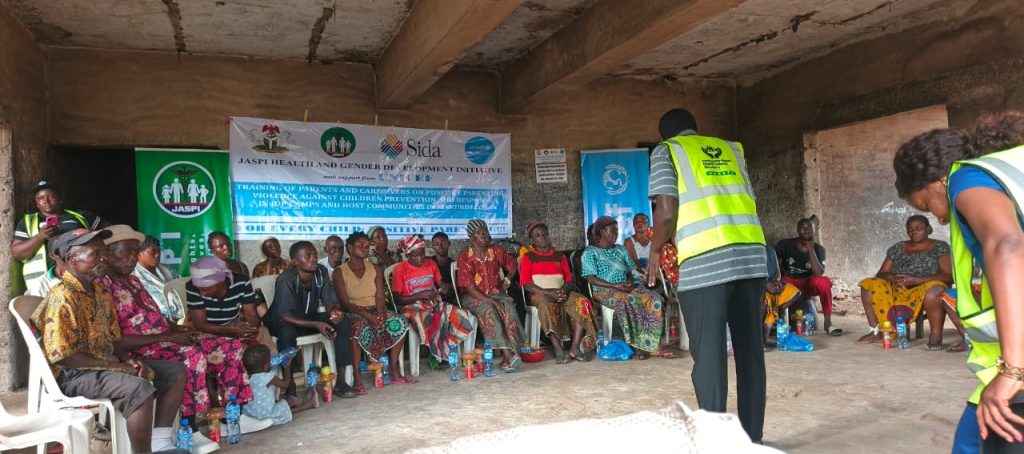
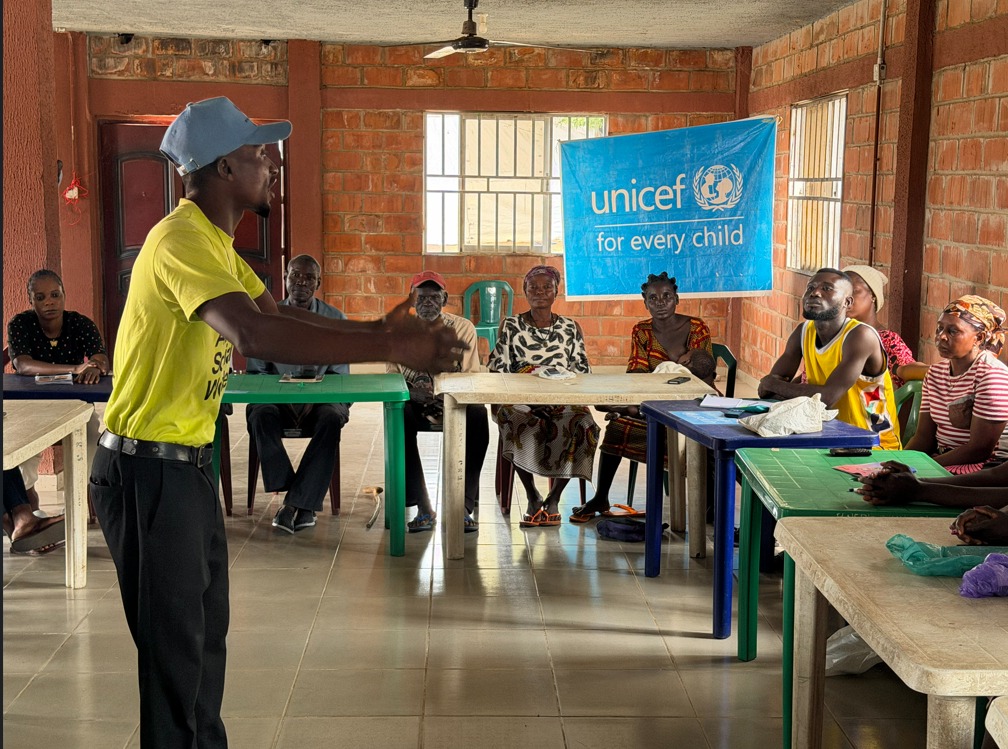
At Ichwa IDP Camp in Makurdi, a facilitator, Lucy Tyonenge said the team is now in Week Four, Session Eight of the programme. “We are here for a sensitization and awareness session on positive parenting with adult males and females in Ichwa IDP Camp. The programme is organised by JASPI and funded by UNICEF,” she explained.
She said the curriculum has so far covered conflict resolution, solving problems without conflict, having quality time together, and open communication with adolescents. “We lay emphasis on discipline and not punishment. Discipline is for the future, for the long term,” she said. “We have treated establishing set goals in the house. The goals should be for the future, not short-term, so that they will be achievable. Yesterday we treated setting rules and routines.”
According to her, parents are taught that rules must apply to everyone, starting with the head of the household. “You being the head of the house, you set a rule, you should ensure that you are the first to abide by the rules. Not feeling you are in charge so you set a rule and you will not abide by it. There should be consequences when there is violation of the rules. And there should be daily routines and shared responsibilities, so that everybody knows: I am responsible for taking care of the house, I am responsible for cooking, I am responsible for providing.”
At the International Market IDP Camp, the facilitator, Lucy Okeke, a case worker on Sexual and Gender-Based Violence with JASPI, said the response has been encouraging. “I was trained for two days on this very programme, Positive Parenting. We have 10 sessions. Session one (1) was on who is a parent and the importance of a parent. Session two (2) was on having feelings with each other. We are now in Session seven (7), which is establishing rules and routines,” she said.
“All the parents that are here are very happy and they are learning a lot. Some of them are giving testimonies on what they have learned and they have established one or two things in their homes that is helping them right now.”
For many participants, the training is reshaping long-held beliefs about parenting. Orjime Christopher, a participant from the International Market IDP Camp, said the programme corrected his understanding of fatherhood.
“We have been made to know who a parent is. We thought maybe a parent should be somebody that gave birth to a child, just like that. But in the course of the programme, we are made to understand that a parent is somebody who has the responsibility to take care of children, not only his own child, but even other children outside,” he said.
“I thought maybe you should be an authoritative kind of father or head of the family, such that whatever you say stands, and you don’t really participate in some of the rules that maybe are set. I also learned that it is not good to punish your child. Before now, I have been the type that will flog my child very well, ensure that he or she gets the pain from what he or she has done. In this programme, it has impacted me, and this is how I am going to mend my ways and also see that my family is a family and we are friends together, not a kind of exercising authority over people.”
He thanked JASPI and UNICEF and appealed for the programme to be extended to spouses who could not attend.
Agee Tena Dominic from Ichwa camp shared a similar story. “This thing is very, very interesting, it helps us a lot. With this, now I know that I can have discussion with my children. It is not everything that people will be doing with other children that you will just leave them doing it, when you see that it is not supposed to be like that, you call that person and then you correct the person,” he said.
“Before this training, when one of my children, who is up to 10 years now, did something, I used to beat him, or if I did not beat him, I would just knock him on the head. But with this training, I have learned a lot. For now, even if he does something that before I used to knock him for, I will just laugh and say, ‘Don’t try this thing next time.'”
Dominic said he is already sharing the knowledge with neighbours. “I am doing it already. I gather both husband and wife and children, together with me, we sit and have a discussion concerning it.”
In Gwer West and Guma Local Government Areas, facilitators Anyoko Mbasen and Achwande Roland shared similar experiences, noting that participants expressed delight at receiving training that promotes discipline over punishment in child upbringing.
According to them, many of the parents admitted that they had previously equated discipline with flogging, but now understand that true discipline guides, teaches and builds character, while punishment only instils fear.
They noted that the sessions have created a safe space for parents to share experiences, unlearn harmful practices and embrace more positive, communicative approaches to raising their children, even in the difficult conditions of displacement.
Patricia Suswam, Executive Director of JASPI, said the intervention was born out of years of working in camps and communities. “Many of us as parents are not educated, neither are we exposed to care of the child. After having interacted with parents in camps, we discovered that they have issues on how they can manage children,” she said.
“This is our fourth year working with the programme. We decided to help these parents so that they will understand what it is to look after their children.”
She explained that positive parenting goes beyond children. “It is not limited only to women. It is extended to husbands, children, even helpers in the house. If you have friendly attitudes towards the people you live with, then you yourself will enjoy your house, and the people around you will also look at you as a good parent, a good mother, a good father.”
“Instead of continuous beating, continuous quarrelling and making them afraid, if a child asks for something and you don’t have it at that particular time, instead of shouting, you will just call the child to come close to you, and find out why he is asking for that thing. Explain that, ‘I know what you want is important, but right now we are limited.’ The child will understand.”
She noted that JASPI is only an implementing partner. The programme is sponsored by UNICEF in collaboration with the Benue State Ministry of Women Affairs, with involvement of the Police, NAPTIP, BENSACA and other stakeholders to ensure sustainability.
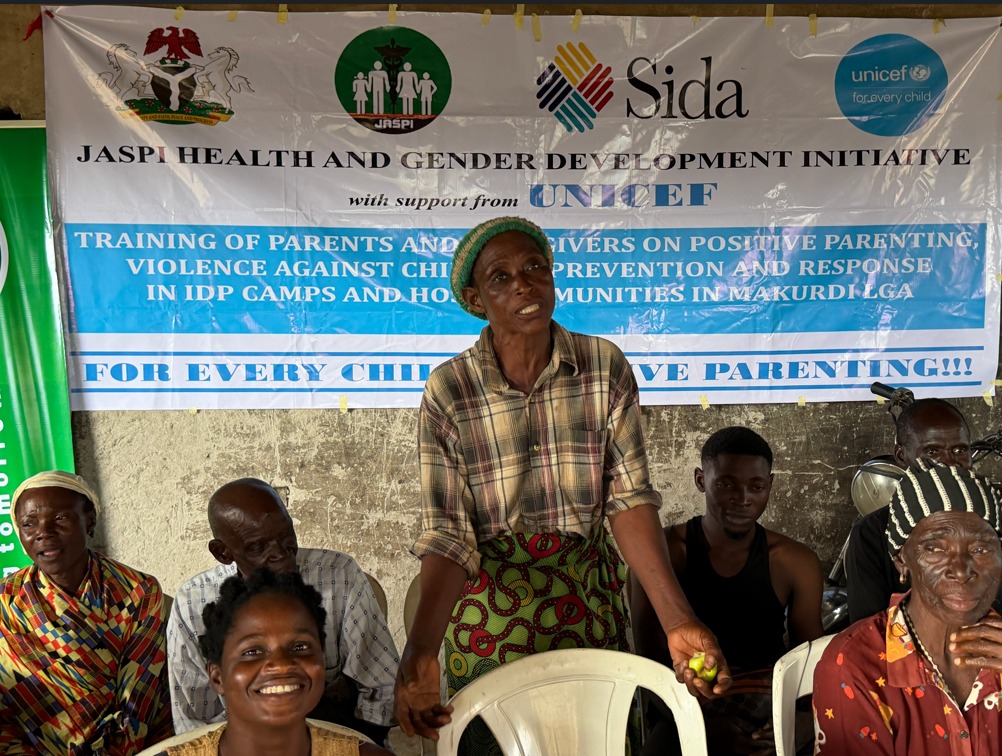
“UNICEF has also worked with Benue State Ministry of Women Affairs. Women Affairs is an arm of state government. So, whatever we are doing, the state government knows. Very soon, Ministry of Women Affairs will train its own staff as well, so that even when UNICEF pulls out and JASPI cannot handle it alone, government staff will continue,” she said.
For UNICEF, the goal is clear: end violence against children by opening communication lines at home. Victor Atuchukwu, Child Protection Specialist with UNICEF Enugu Field Office, which supervises Benue State, said positive parenting may sound like a small phrase but it can make or mar the world.
“The world is a good place when you have children who are treated and brought up positively. When they are not nurtured positively, all they can exhibit is negative attitudes. A child is a tabula rasa – whatever he internalises is exactly what he or she is going to give out,” he said.
“What we are looking at achieving is ending violence against children, especially sexual abuse. How do we get parents to have an open communication, to have an open relationship with their kids?”
Atuchukwu noted that in many homes, children cannot express their feelings, even on issues like menstrual hygiene. “Maybe the first time the child experiences a menstrual cycle, the first message they give is that, ‘If you meet a man, you will get pregnant,’ which is a lie. But how can you have that open communication so your child can even be able to tell you when he or she is experiencing or there is an attempted abuse, sexually, physically, emotionally, either from an outsider or from an insider?”
He said the consequences of closed communication include teenage pregnancy and school dropout, with parents blaming children for issues rooted in ignorance and poor parenting.
The 10-session module, he said, is designed to build relationship and trust between children and parents and change behaviours and attitudes. “These participants are here as representatives of all the families in this camp and host communities. They are still going to share the message. We want to have a situation where children will not be scared again when they hear the voice of their mother or father coming into the house. They will be happy to run to them, embrace them, tell them welcome, and tell them everything that has happened in their absence.”
Matthew Hemba, Programme Manager for JASPI, summarised the objective: to reduce abuses and improve child protection. “If this relationship is improved, the parent understands the child, the child understands the parent. The child comes to the parent for issues they are having. If a child is thinking of eloping, she will come to the mother, ‘Mama, somebody is asking me to elope with them.’ We are trying to prevent child marriage. If somebody abuses a child or deceives or coerces a child to do something inappropriate, they can easily come to the parent and express themselves before they indulge in such activities.”
He added that participants are expected to be community watchers and peer educators. “We are not reaching everybody in the community, just a few due to limited resources. The few that we have will go back to their different meetings, communities and gatherings and pass it on to other parents. They will also act as watchers, people who will be watching and seeing issues in their community and help to address them.”
At the end of the day, organisers say, the activity is tailored to support children – for every child.