

…demands justice, inclusivity
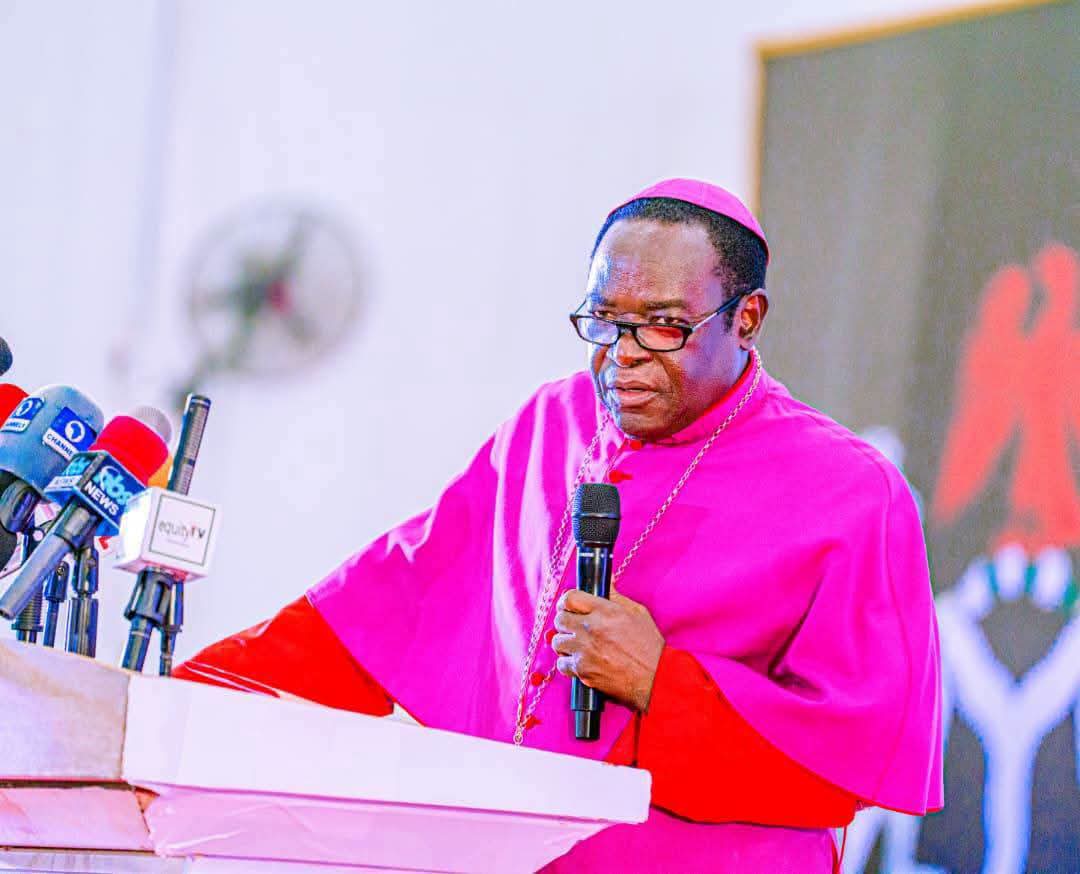
The Catholic Bishop of Sokoto Diocese, Most Rev. Dr. Matthew Kukah has said the guarantee for peaceful coexistence lies in the effective management of the people’s diversity.
Speaking in Lafia on Wednesday during his keynote address at the Nasarawa State anniversary lecture, titled “Unity in Diversity: Three Decades of Building a Cohesive Nasarawa State — Issues, Challenges and Prospects,” the cleric asserted that Nigeria’s political decay and stagnation stem from a collective failure to manage its pluralism and foster a genuine sense of national belonging.
Reflecting on Nigeria’s political history, Bishop Kukah revisited the famous encounter between Dr. Nnamdi Azikiwe and Sir Ahmadu Bello, where Azikiwe advocated forgetting differences while Bello urged understanding them.
”Where we are in Nigeria today suggests that we probably neither forgot nor understood. So, managing diversity remains a work in progress,” Kukah said.
Kukah criticised the political elite for squandering the nation’s resources and encouraging primitive accumulation. He emphasised that Chapter 2 of the Nigerian Constitution explicitly mandates that citizen welfare, regardless of tribe or creed, must remain the primary purpose of government.
Challenging leaders to distinguish between simple equality and systemic justice, Kukah stated: “People often confuse equality with justice. If a fence is six feet tall and someone tall can see over it, but a shorter person cannot, redressing that inequality requires graciously providing a stool for the shorter person so everyone can watch the match. A society that fails to be sensitive to this creates friction.”
Describing Nasarawa as a “miniature Nigeria” with over 30 ethnic groups, Kukah highlighted the strategic location of Akwanga as the geographic center of the country, capable of linking all geopolitical zones if properly harnessed through intentional governance and infrastructure.
Delivering another lecture, titled “Nasarawa State at 30: From Foundation to Transformation,” former Independent National Electoral Commission (INEC) Chairman, Prof. Attahiru Jega, reviewed the state’s evolution since its creation in October 1996 by the late General Sani Abacha. Jega noted that the state inherited virtually no infrastructure and received no initial take-off grant.
”As former Governor Abdullahi Adamu once noted, Nasarawa State started with ‘one tarred road, no water board, and no secretariat.’ Today, statistics reflect notable progress across key sectors, including roads, education, and healthcare,” Jega stated.
Jega warned, however, that widespread governance deficiencies across the country have fueled rising expectations among young people, urging political leaders to adopt transformational leadership over routine budgeting.
In his remarks, Governor Abdullahi Sule expressed gratitude to both speakers for their candid assessments and reaffirmed his administration’s commitment to inclusive development.
Responding to Bishop Kukah’s points on Akwanga, Governor Sule noted that the state has upgraded the town’s central corridor with a flyover and underpass network to boost regional commerce.
”Our diversity must remain a source of strength rather than division.The lessons of the past three decades should guide us as we build a state where every citizen feels a sense of belonging and where the aspirations of future generations receive the attention they deserve,”Governor Sule declared.
He called for sustained sub-regional synergy, political inclusion, and continued capital investment across solid minerals, agriculture, and digital infrastructure.
The event was attended by former military and civilian governors of Plateau and Nasarawa States, as well as past and serving senators and government officials from Benue State.