


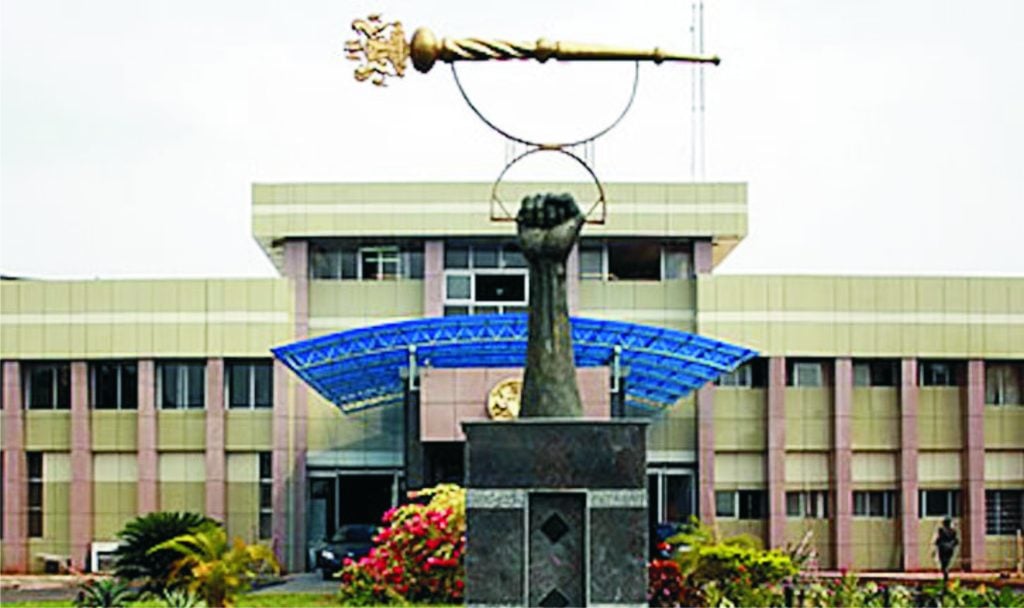
The Benue State House of Assembly has passed into law a Bill for an Act to alter the Constitution of the Federal Republic of Nigeria, 1999, to provide for the establishment of State Police Service and for related matters.
The House passed the Bill into law during Tuesday’s plenary presided over by the Speaker, Rt. Hon. Alfred Emberga, held at the hallowed chamber of the Benue State House of Assembly, Makurdi.
According to the law, the Federal Police Force and all its hierarchies, duties and responsibilities would remain intact, while the State Police Service would be headed by a State Commandant.
Earlier, in a Committee of the Whole to consider the Bill clause by clause, the Majority Leader of the House, Hon. Peter Ipusu, stated that the National Assembly formally advanced the 1999 Constitution (Sixth Alteration) Bill, 2026, by transmitting the harmonised amendment package to all 36 State Houses of Assembly on Wednesday, September 16, 2026.
He further stated that this step officially moves the legislative proposals out of the federal chambers into the state-level ratification phase.
According to Hon. Ipusu, the document outlines the 6th Alteration Bill of the 1999 Constitution, proposing the establishment of State Police Services. He maintained that it details amendments to various sections of the Constitution to facilitate the creation and operation of state-level police forces alongside the Federal Police Service. He added that the key provisions include the responsibilities, funding, and operational guidelines for both Federal and State Police Services, ensuring compliance with national standards.
He further explained that, pursuant to Section 9 of the 1999 Constitution, the amendments require approval by resolution from at least two-thirds of the State Houses of Assembly, which is 24 out of 36 states, before they can be sent to the President for assent.
He explained that the proposed introduction of State Police in Nigeria offers several key advantages for local security and governance. These include better local knowledge, as officers recruited locally understand the language, culture, geography, and specific security challenges of their communities. It also ensures faster response times, as proximity to grassroots areas allows state-controlled forces to react more quickly to crimes, emergencies, and local disturbances.
Other advantages are improved grassroots intelligence, as local residents are more likely to share vital information and trust officers who live and work within their neighbourhoods, and decongestion of the Federal Force, which will relieve the national Nigeria Police Force of routine local law enforcement to enable them to focus on national security, border control, and major organised crimes.
The establishment of State Police will also allow for tailored security strategies, as individual states can design customised responses to address specific regional threats such as rural banditry, farmer-herder clashes, or urban crime. It will further lead to job creation by establishing and maintaining state police structures, thereby creating local employment opportunities, and it aligns with true federalism by decentralising command and shifting accountability closer to sub-national leaders.
He further explained that each State Legislature is independent and will debate the proposals using its own legislative procedures. Once at least 24 states pass matching resolutions approving a specific amendment item, that component of the Constitution of the Federal Republic of Nigeria (Sixth Alteration) Bill will move to the executive branch for presidential assent.
Seconding the motion, the member representing Ogbadibo State Constituency, Hon. Samuel Agada, stated that the establishment of State Police would drastically reduce crime rates in the state and communities, noting that personnel of the State Police would be members of a particular community and familiar with the terrain, making it easier to identify and curb crime and criminality.
The Speaker, Rt. Hon. Alfred Emberga, asked the Clerk of the House, Dr. Bem Mela, to read the Bill for the third time, and he obliged accordingly.
It could be recalled that the two chambers of the National Assembly, the Senate and the House of Representatives, had earlier passed the Bill into law.