

… Says state can lead Nigeria’s fish production
The Fisheries Cooperative Federation of Nigeria (FCFN) has commended the Taraba State Governor, Agbu Kefas for his commitment to developing fisheries and aquaculture as a tool for job creation and economic diversification.
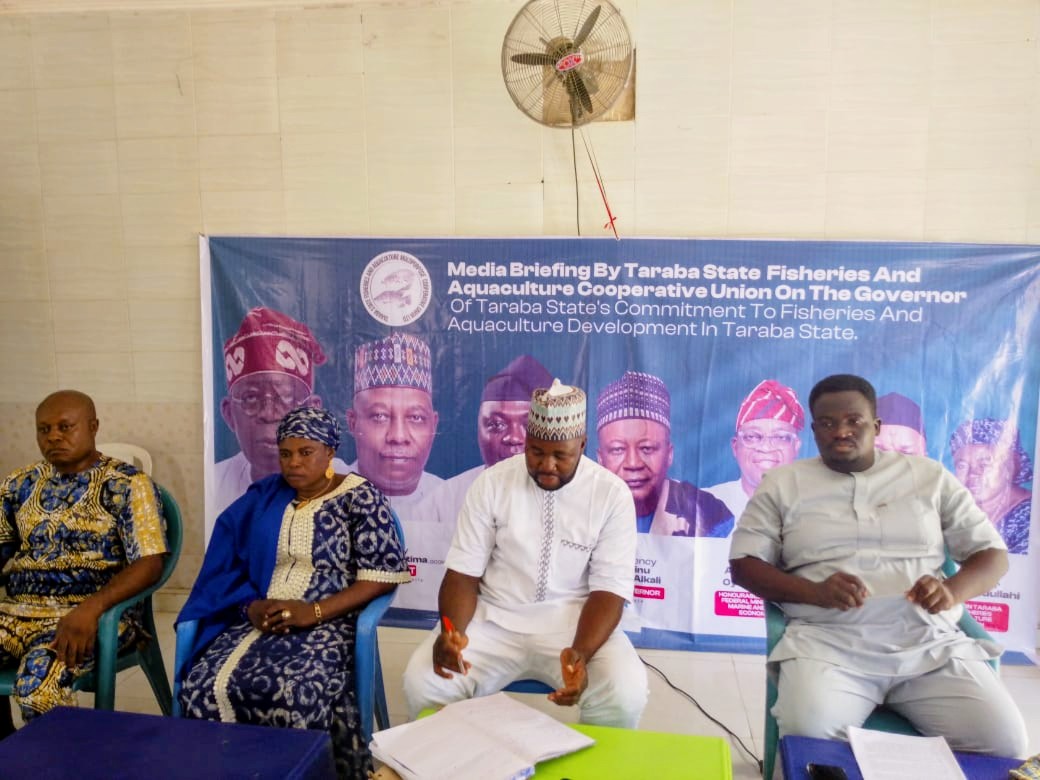
Addressing journalists in Jalingo on Friday, the Acting National President of FCFN and National Coordinator of the National Fisheries and Aquaculture Value Chain Database Capture Programme (NFAVCDCP), Mr. Mashi Gabriel Sani, described the Governor’s declaration as timely and strategic.
Sani said Taraba State, with its vast network of rivers, lakes, dams and wetlands, is naturally endowed for fisheries and aquaculture, but the potential has remained largely untapped.
“For many years, fisheries and aquaculture have received insufficient attention and investment. Fish farmers, fisherfolk, processors, traders, women and young people continue to face challenges including high cost of feed, inadequate fingerlings, limited access to finance, poor processing and cold-chain infrastructure, weak extension services and limited market opportunities,” he said.
He welcomed the Governor’s indication that from 2027, the state will roll out strategic measures to harness its aquatic resources for food security, processing, employment and community livelihoods.
The FCFN President disclosed that at the federal level, the Federal Ministry of Marine and Blue Economy has constituted a Technical Committee on Accelerating Fish Production in Nigeria to identify practical measures to boost fish production, strengthen the value chain and create employment.
Sani, who is a member of the committee, said he would use his membership to ensure that Taraba’s potential and the challenges facing its fish farmers and fisherfolk are adequately represented at the national level.
As part of its proposals, the federation is advocating for a dedicated Taraba Fisheries and Aquaculture Development Programme from 2027. The programme, he said, should include a comprehensive fisheries master plan, a state fisheries and aquaculture database, input and hatchery centres, aquaculture clusters, fish processing and cold-chain facilities, improved access to finance, and special intervention programmes for women and youth.
The federation also recommended the establishment of a dedicated Ministry of Fisheries and Aquaculture or a properly empowered State Fisheries and Aquaculture Development Agency to give the sector institutional focus.
“Taraba has the water resources. Taraba has the people. Taraba has the opportunity. What we need now is deliberate investment, proper coordination and sustained government support,” Sani stated.
He noted that if properly developed, fisheries and aquaculture could become one of the major pillars of Taraba’s economy, creating thousands of direct and indirect jobs while improving food security, household incomes and rural livelihoods.
Sani reaffirmed the readiness of the federation to work with the Taraba State Government, the Federal Government, development partners, investors, financial institutions and cooperative members to translate the vision into concrete results.
“Fisheries can feed Taraba. Fisheries can employ Taraba. Fisheries can help diversify Taraba’s economy. The time to invest in Taraba’s fisheries and aquaculture sector is now,” he added.