

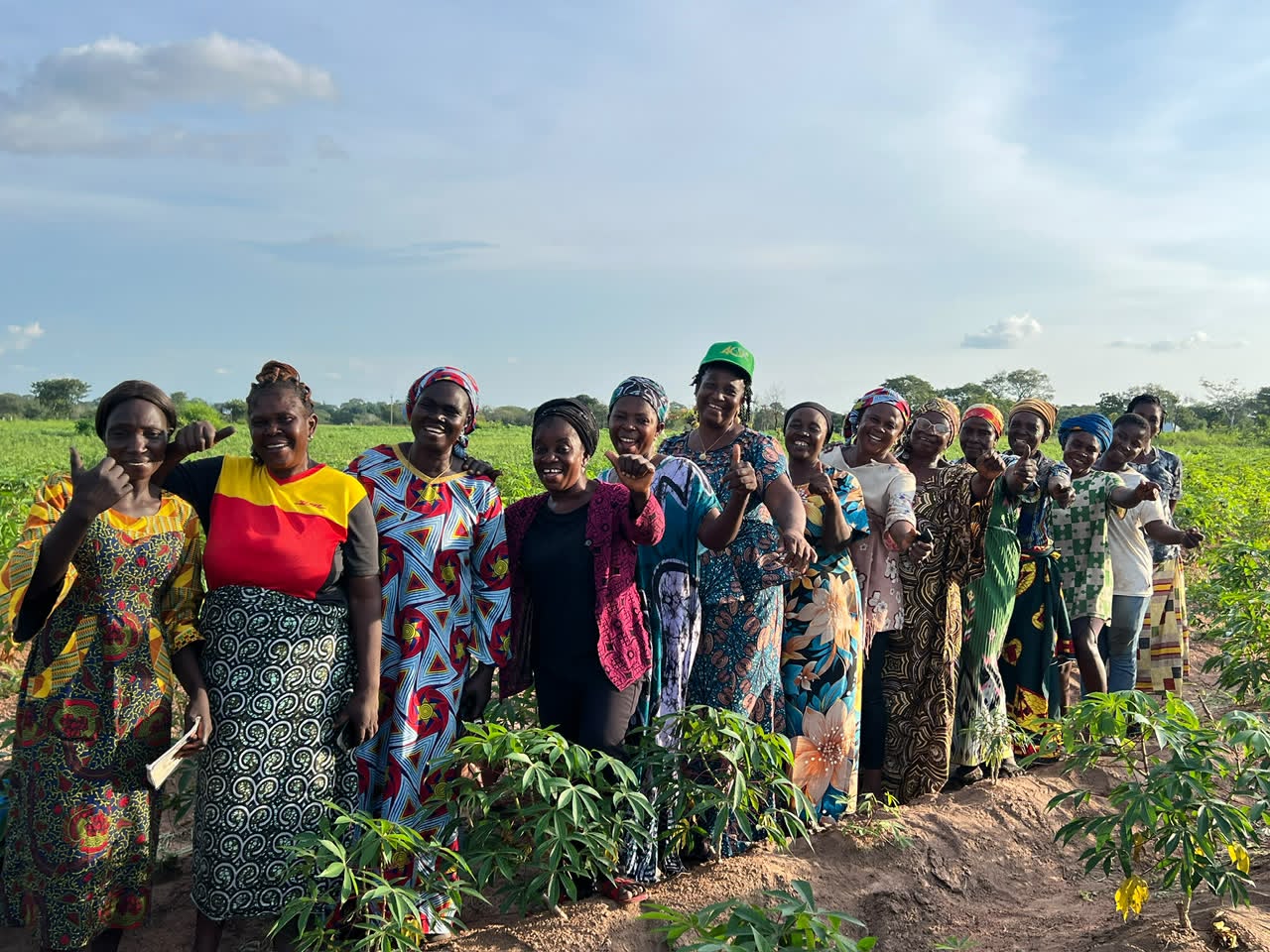
The Benue rural woman has long been perceived as the backbone of household food security. This impression is gradually shifting to the successful agribusiness woman.
During a two-day media field tour organised by Sasakawa Africa Association, Nigeria (SAA-NIG), funded by Japan’s Nippon Foundation, journalists visited project sites across Benue State to assess the impact of SAA’s three-year agricultural initiative and women involvement.
At the Mbatie and Mbatsaase communities of Buruku Local Government Area, journalists gathered that targeted mechanisation, training, and improved seeds are helping female smallholders become key drivers of local food production.
The Divine Open Doors Women Multipurpose Cooperative Society in Mbatie community, which brings together over 350 women across seven LGAs nevertheless faced a major setback as 18 hectares of their cassava farm were vandalized and looted, leaving members demoralised.
”This devastated us so much that most of our members did not want to work together again. But when Sasakawa learnt of this, they came to our aid,” said Mrs. Chichi, a leading member of the cooperative.
To help them rebuild, SAA provided an M807,000 relief grant alongside an 18-horsepower tiller valued at N13 million, cutting both field labor and operational costs.
”Manually, it takes 10 people two days to clear a hectare at N60,000. Now, with the power tiller, a hectare is done in a single day. We pay the operators N20,000 and spend N7,000 on diesel just over N30,000 total. That gave us the encouragement to return to farming,” Mrs. Chichi explained.
The cooperative now cultivates 58 hectares of cassava and soybeans while expanding into processing. By turning raw cassava into packaged, odorless flour with a longer shelf life, the group is expanding beyond local markets.
”With this packaged product, we can supply anywhere in the country. We want to supply the Benue market and expand into the rest of Africa,” Mrs. Chichi said.
Beyond profits, the group builds goodwill within the community. Divine Open Doors operates a dividend-sharing model for its members while allocating a portion of their harvest to nearby residents.
”Every year, we set aside one hectare for the community to harvest. It keeps our farm secure. In the past, they didn’t have these improved cassava varieties, but now they do because we share our harvest. That is why no one has stolen from our farm this year,”Mrs. Chichi explained.
In neighboring Mbatsaase, poor roads made it difficult for farmers to get quality inputs from urban centers like Makurdi. SAA addressed this by establishing community-based seed multiplication plots through the Building an Economically Sustainable and Integrated Cassava Seed System (BASICS-II) project.
Jonathan Yassah, SAA-NIG Programme Officer for Inclusive Markets and Agribusiness Development, noted that training farmers to treat seed production as a business has delivered real financial gains.
”Farmers learn to produce improved cassava seeds and sell the stem cuttings. Two years ago, some were making N1 million to N1.5 million per hectare from stem sales alone-the tubers were extra profit. In Mbatsaase, we also introduced high-yielding, non-shattering soyabean seeds (TGX 1951-3F) so farmers don’t have to travel long distances for good inputs,” Yassah said.
For local farmers like Felicia Luper, direct access to improved seeds and fertilisers has changed their outlook.
”This is the first time we are receiving support like this in Mbatsaase, and we are very happy. We thank Sasakawa for coming to our community,”Luper said.
Dr. Moshood Sulaiman, SAA-NIG Programme Officer for Safe, Adequate, and Nutritious Food Production and Utilization, noted that mechanization boosts yields while reducing physical strain.
”Mechanisation alone can increase farm production by 20 to 30 percent, and the power tiller works 20 to 40 times faster than manual labour.To keep the equipment running, we also train local operators on routine maintenance and troubleshooting,”Dr. Sulaiman said.
SAA Communication Officer, Moses Nongoatse emphasised the importance of reaching remote areas.
”If we don’t bring improved seeds here, where else should we take them?” With good agronomic practices and access to quality inputs, higher crop yields will directly improve smallholder farmers livelihoods,” he said.
Through training, mechaniaation support, and processing, SAA-NIG and the Nippon Foundation are helping rural women in Benue move beyond subsistence farming into commercial production, boosting household incomes and strengthening local food production.
The State Coordinator for the Sasakawa Africa Association (SAA) in Benue State, Comfort Anum, stressed that genuine agricultural development requires direct engagement with smallholders in their fields, not just official announcements.
She noted that SAA is easing economic pressure on rural producers by distributing free farm inputs, including fertilisers, herbicides, and insecticides.
The programme currently spans eight Local Government Areas (LGAs): Vandeikya, Ushongo, Gboko, Konshisha, Buruku, Tarka, Gwer East, and Guma. Through 15 Extension Agents, SAA coordinates 60 farmer groups, directly supporting over 1,500 primary beneficiaries while creating a spillover effect in neighboring communities.
Anum explained that the initiative rests on three core pillars: Restoring degraded farmland through climate-smart regenerative agriculture, integrating nutrition-sensitive farming so families grow nutrient-dense food alongside commercial crops and helping rural producers transition from subsistence mindsets to sustainable agribusinesses.
Central to the strategy are Community Development Plots managed by extension agents. These demonstration sites allow non-participating farmers to observe high-yield planting, proper fertilizer application, and pest management firsthand, encouraging broader technology adoption.
Addressing questions on geographic focus-specifically why operations have not expanded into Zone C, Anum cited budget limitations. She added that while SAA is maximizing its available resources, scaling the program across all 23 LGAs in Benue will require counterpart funding from the state government.