

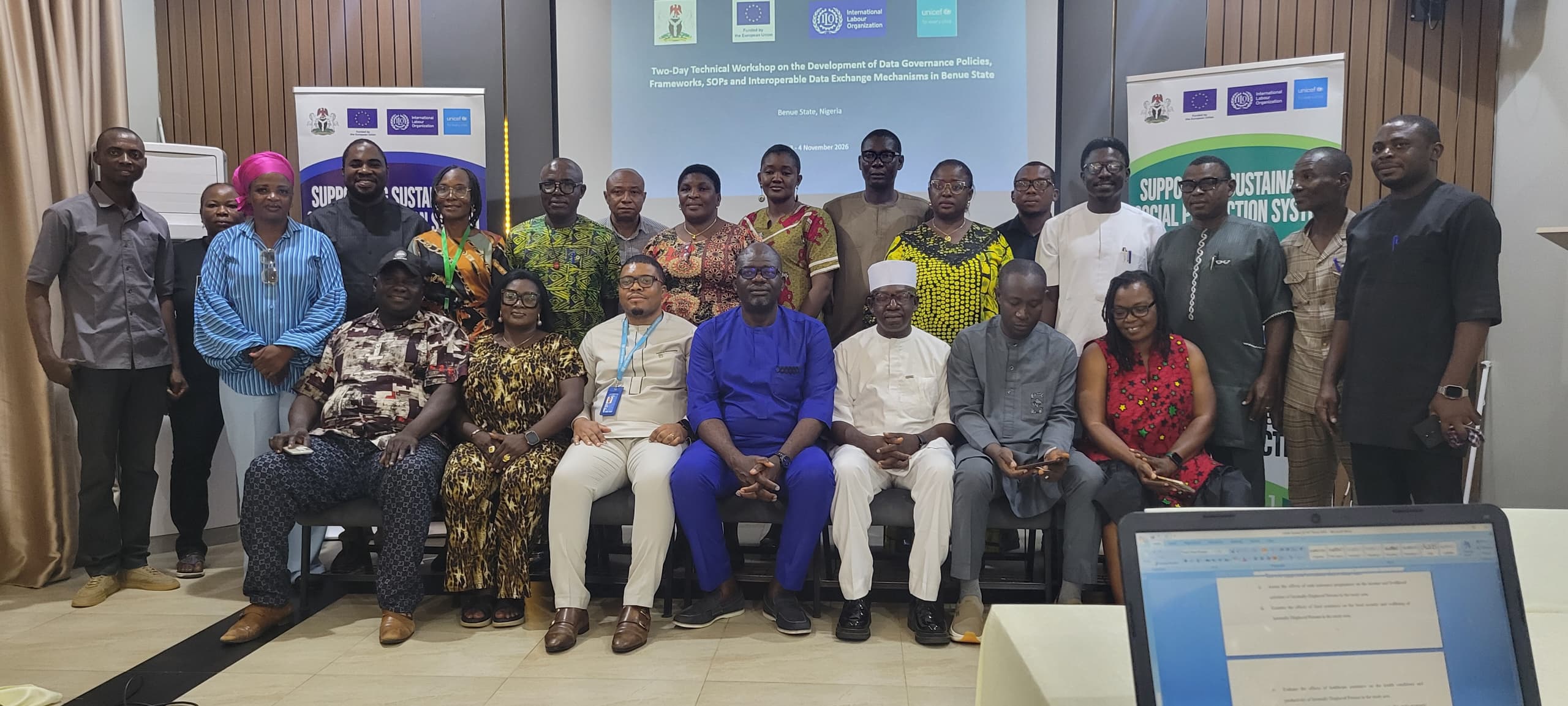
The Benue State Budget and Economic Planning Commission (BSBEPC), with the support of the International Labour Organization, the European Union and UNICEF, on Tuesday, November 3, 2026, convened a stakeholder workshop for the development of Data Governance Policies, Frameworks, Standard Operating Procedures (SOPs) and Interoperable Data Exchange Mechanisms for the Social Protection Management Information System (SP-MIS) in Benue State.
Declaring the two-day workshop open the, the director covering the Permanent Secretary of the Commission, Orinya Ogenyi, described data as the foundation of effective planning, budgeting and service delivery.
He noted that Benue State currently runs several social protection programmes, including the State Social Register, Farmer Register, Health Insurance, School Feeding, Cash Transfers and Humanitarian Response, but each operates in isolation.
According to him, different Ministries, Departments and Agencies (MDAs) hold data in different formats, with no common standard for sharing, protection and use, a situation that makes the assignment timely.
Ogenyi said the workshop seeks to achieve four key objectives: a Data Governance Policy that defines data ownership, access and privacy protection in line with the Nigeria Data Protection Act; clear Frameworks and SOPs for data collection, validation, updating, storage and sharing across MDAs; interoperability to ensure that the Social Register can communicate with Agriculture, Health, Education, Women Affairs and Humanitarian MIS under the principle of one citizen, one identity, one truth; and sustainability through a system that is government-led and government-owned, rather than dependent on any single partner or project.
He said under the leadership of Governor Rev. Fr. Dr. Hyacinth Iormem Alia, Benue State is moving from fragmented interventions to a unified, shock-responsive social protection system, and that a functional SP-MIS with strong governance is non-negotiable.
He therefore urged the technical team, MDAs and partners, including UNICEF and others, to make the session practical and to leave with draft documents that can be adopted, not just a communique.
Speaking on behalf of the International Labour Organization (ILO) Country Director for Nigeria, Ghana, Liberia and Sierra Leone, Dr. Vanessa Phala, the National Project Officer for Supporting Sustainable Social Protection Systems in Nigeria (SUSI) Project, Benedict Obute, commended the leadership of the Social Protection Technical Working Group and the BSBEPC for convening the workshop.
Obute recalled that a similar engagement was held earlier in the year to assess the MIS landscape in Benue State, noting that the current workshop is a continuation of that process.
He said the earlier assessment revealed fragmentation of data as a major challenge, with social protection programmes implemented in silos and different databases lacking a common platform for harmonisation.
He explained that a key focus of the SUSI Project is to enhance the Management Information System of social protection institutions and establish handshake mechanisms for data sharing and exchange, to ensure interoperability.
According to him, interoperability will help reduce duplication, enable policymakers to understand the extent of social protection implementation, and inform evidence-based policy decisions.
Obute stressed that the workshop was interactive and not a seminar, urging participants to contribute inputs on the programmes they implement, the documents and SOPs they already have, and how existing systems can be improved.
In his remarks, a Lead Consultant on Social Protection, Dr. Iorwakwagh Apera, lamented that not much premium is placed on data and the use of evidence to drive social policymaking in many states. He disclosed that, although the situation is gradually improving.
He traced the evolution of social protection in Nigeria, noting that about seven years ago, attention shifted from general poverty alleviation to strengthening systems and structures, with the approval of the first Social Protection Policy by the Executive Council in 2017 and the development of the Social Register and its database.
Dr. Apera said although early efforts focused more on infrastructure without adequate attention to systems and processes, the vision for the Social Register was clear on data reliability from the beginning.
He described the Social Register as the only national database designed from inception for interoperability, unlike the voter register, international passport, tax and driver’s licence databases which do not speak to one another.
He said eight years down the line, interoperability has now become central, and the objective of the workshop is to ensure that data speaks to each other through governance structures that support the use of data and evidence.
He stressed that establishing minimum standards would guide all partners and ensure that data collected in Benue supports the state’s planning, impact measurement and decision-making.
Dr. Apera also emphasised continuity in governance, noting that data from previous years informs budgeting, implementation reviews and gap analysis for subsequent years.
He cited the example of the Social Register, which was initially doubted along political lines but later proved its authenticity and value for governance, after scrutiny showed it was more than a database of people but a tool for planning and service delivery.
He added that reliable data would help eliminate duplication and address long-standing challenges, citing Benue’s historical HIV and AIDS data as an example of how inaccurate or poorly managed data can undermine decades of programming.
In a goodwill message, the Chairman of the Nigeria Labour Congress (NLC), Benue State, Comrade Terungwa Igbe, represented by Comrade Timothy Atsaakaa, described the workshop as apt, saying data is key to everyday activities and guides effective decision-making. He urged participants to make valuable contributions.
Similarly, the Executive Director of the Emmanuel Teryila Memorial Liberty Foundation, Mrs. Adi Vera, speaking on behalf of Civil Society, expressed delight that the MIS process, which started earlier, was being revived.
She urged participants to pay attention and participate actively, while encouraging partners to do their best to keep the process on track. She also disclosed that the National Association of Social Protection is working to extend its chapter to Benue State.
The workshop, which ends on Wednesday, November 4, 2026, is expected to produce draft governance policies, frameworks, SOPs and interoperability mechanisms that will guide data management for social protection programmes in Benue State.